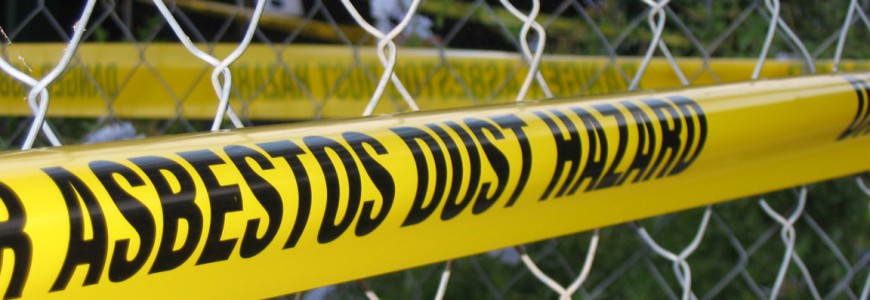
Asbestos is the hidden killer found in almost any building built before the year 2000 – including houses, schools, and hospitals – which causes around 5000 deaths every year.
There are four main diseases associated with inhalation of asbestos fibres:
- Asbestosis, a scarring of the lung tissue caused by asbestos
- Mesothelioma
- Lung cancer
- Pleural thickening, a non-malignant disease affecting the lung lining
Current evidence suggests that asbestos can also cause laryngeal cancer and may be implicated in causing pharyngeal, stomach and colorectal cancers.
Asbestosis
Asbestosis is defined as lung fibrosis caused by the inhalation of asbestos fibres. Diagnosis is made on the basis of clinical features, X-ray appearances and a history of heavy asbestos exposure. It is generally recognised that heavy asbestos exposures are required in order to produce clinically significant asbestosis within the lifetime of an individual. Current trends therefore largely reflect the results of heavy past exposure.
Mesothelioma
Mesothelioma is a formerly rare form of cancer in which malignant (cancerous) cells are found in the mesothelium, a protective sac that covers most of the body’s internal organs. It principally affects the pleura (lining of the lungs) and peritoneum (surrounding the lower digestive tract). Most of the people who develop this type of cancer have worked on jobs where they inhaled asbestos particles.
Working with asbestos is the major risk factor for mesothelioma. The typically long delay between first exposure to asbestos and death from mesothelioma (rarely less than 15 years, but possibly as long as 60 years) means that deaths occurring now and most of those expected to occur in the future are as a result of the industrial conditions of the past rather than current working practices. This latency period means that the effectiveness of current controls cannot yet be assessed from the mesothelioma mortality figures.
A history of asbestos exposure at work is associated with about 80% of all cases. However, mesothelioma has been reported in some individuals without any known exposure to asbestos.
Updated statistical modelling of mesothelioma deaths during the period 1968-2001 in males aged 20-89 was used to produce an estimate of the future peak number of deaths to males and females of all ages:
- The total number of mesothelioma deaths in Great Britain is currently predicted to peak at a level of 1950 to 2450 deaths each year during the period 2011 to 2015.
- The updated modelling suggests that total number of mesothelioma deaths in men aged 20-89 in Great Britain will peak at a level of 1650 to 2100 deaths each year during the period 2011 to 2015.
- The total number of mesothelioma deaths in women in Great Britain is predicted to peak at a level of 250 to 310 deaths each year, though this estimate is more uncertain since it is derived by simply applying the results for men to the average proportion of deaths among women.
Although these projections rest on a number of uncertain (and largely unverifiable) assumptions, the timing and scale of the maximum annual death toll is not particularly sensitive to these uncertainties. What is unknown is the rate at which the numbers will fall after this peak has been reached.
Lung cancer
Asbestos has been recognised as an important risk factor for lung cancer for many years. However, although lung cancer death statistics for Great Britain are readily available, the number of deaths directly attributable to asbestos cannot be easily determined. This is because there are a number of agents that can cause lung cancer – most importantly, tobacco smoke – and lung cancers resulting from asbestos exposure are clinically indistinguishable from those caused by these other agents.
In populations with heavy asbestos exposures, there have typically been at least as many, sometimes up to ten times as many, excess lung cancers as there have been in the normal population. The ratio depends on a range of factors – the most important of which are the type of asbestos and level of exposure, age at exposure and smoking – and so one cannot be too precise about the overall ratio.
Two lines of argument suggest that the ratio of asbestos-related lung cancers to mesothelioma cases in the British population as a whole is towards the lower end of the range of 1-10, as estimated from the epidemiological studies.
Firstly, a study of lung cancer mortality in relation to indices of asbestos exposure and smoking habits in the west of Scotland suggested a ratio of around two asbestos lung cancers per mesothelioma case for this region.
Secondly, analyses of mesothelioma deaths in Great Britain by occupation and geographical area suggest that substantial numbers of deaths may have arisen in workers other than those that were most heavily exposed.
As a result, the HSE has for some years used the rule of thumb that there are 1-2 asbestos-related lung cancers for every mesothelioma death.
Pleural plaques
Another disease associated with asbestos exposure is diffuse pleural thickening. The pleura is a two-layered membrane which surrounds the lungs and lines the inside of the rib cage. Some asbestos fibres inhaled into lungs work their way out to the pleura and may cause fibrosis or scarring to develop there. This causes the pleura to thicken and this may show up on a chest X-ray or CT scan.
Pleural thickening occurs in two forms:
- Diffuse pleural thickening, which extends over a large area and may restrict expansion of the lungs, leading to breathlessness; and
- Pleural plaques, which are localised areas of pleural thickening, and do not usually interfere with breathing.